- The Word
- definition in English
- Picture
- Similar words
- opposite words
Category: My Past
lessons I’ve learned from my past
How to analyze Poetry
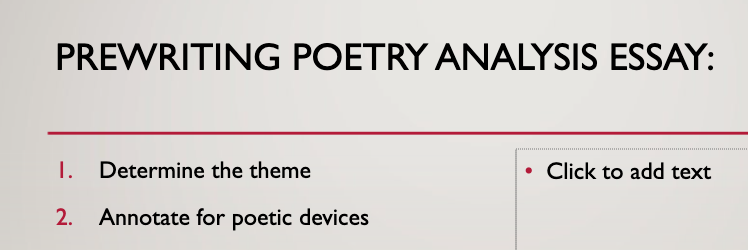
First what is the topic? (one word, the BIG IDEA)
It is the subject or focus of the poem.
example: teamwork, death, homework, love
Then, what is the theme? (Using the topic, create a sentence that describes the theme).
A theme is a sentence that gives a claim about a topic.
Examples:
topic: teamwork
theme: Teamwork is only effective if everyone contributes.
topic: homework
theme: Homework is annoying but necessary.
topic: death
theme: Death is not something we should fear.
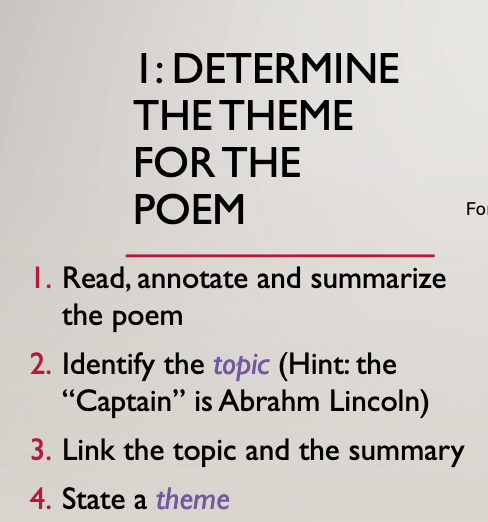
How do we unlock a theme in a poem or text.
1) annotate + summarize
2) identify the topic
3) How does our annotation/summary link to the topic?
4) State the theme.
The Little Seedling
Poem:
A little seed in the ground,
Waits for rain to come around.
Sunlight whispers, “Grow, be free,”
Now a tree for all to see.
1. Annotation:
Line 1: “A little seed in the ground” → Introduces the subject (a seed) and its setting (the ground).
Line 2: “Waits for rain to come around” → Suggests patience and dependence on nature.
Line 3: “Sunlight whispers, ‘Grow, be free'” → Personifies sunlight, encouraging growth and freedom.
Line 4: “Now a tree for all to see” → Shows the seed’s transformation into a tree, symbolizing achievement and visibility.
Summary:
The poem describes the journey of a seed that patiently waits for rain and sunlight to grow into a tree. It highlights the natural process of growth and transformation, emphasizing the seed’s potential and eventual success.’
2. Identify the Topic
topic: growth and transformation.
3. How does our annotation link to the topic?
Our annotation shows personification (sunlight whispers)
and imagery “little seed”, “in the ground”, “rain”.
Summary –
The the poem uses personification and natural imagery to convey the idea of growth and potential.
4. Theme
With time, care, and the right conditions, even the smallest beginnings can transform into significant success.
The Ocean’s Heart
The Ocean’s Heart (with annotation)Metaphor: “The ocean is a restless beast” (compares the ocean to a wild animal).
Simile: “Its waves like claws that never cease” (compares waves to claws using “like”).
Personification: “It roars with anger, hums with grace, ” (ocean roars and hums)
Metaphor: “A mirror of time” (compares the ocean to a mirror reflecting time).
Beneath the surface, secrets hide,
Simile: “Like treasures locked deep inside” (compares secrets to treasures using “like”).
Metaphor: “Its heart, a mystery” (compares the ocean’s depths to a heart).
A world of wonder, where dreams reside.
1) Summarize
Summary:
The poem describes the ocean as a powerful, unpredictable force, comparing it to a restless beast and a mirror of time. It highlights the ocean’s dual nature—its surface is wild and untamed, while its depths hold hidden secrets and beauty. The ocean is portrayed as both mysterious and awe-inspiring, a place where dreams and wonders coexist.
2) Identify a Clear Understandable Topic
topic: nature’s duality
3) How Does Our Annotation and Summary Link to the Topic?
The poem uses metaphors and similes that describe the ocean’s characteristics, such as its restless surface (“restless beast,” “waves like claws”) and its mysterious depths (“treasures locked deep inside,” “heart, a mystery”).
The summary ties these elements together, showing how the ocean’s surface and depths reflect its dual nature. This directly links to the topic by explaining how the poetic devices illustrate the ocean’s power and mystery.
4) State the Theme
theme:
Nature wild and powerful, yet in its depths, there lurks full of mystery and hidden beauty.
The Gigantic Storm
“The Gigantic Storm”
The wind whipped wildly, whirling waves so wide,
The sky screamed silver, lightning lit the tide.
The rain roared louder than a lion’s fierce cry,
A storm so strong it scraped the stars from the sky.
1) Annotate and Summarize
Annotation:
Alliteration: “wind whipped wildly,” “sky screamed silver,” “lightning lit the tide,” “rain roared louder,” “storm so strong,” “scraped the stars.”
Hyperbole: “it scraped the stars from the sky” (exaggeration to emphasize the storm’s power).
Imagery: Vivid descriptions of wind, sky, lightning, rain, and stars.
Summary:
The poem describes an intense storm using exaggerated language and repeated sounds. The wind, sky, lightning, and rain are portrayed as overwhelmingly powerful, with the storm even affecting the stars.
2) Identify a Clear Topic
Topic: Nature’s power
Nature’s power –> such as the hyperbole (exaggerating the storm’s strength)
Nature’s power –> alliteration (emphasizing the storm’s intensity through sound).
Nature’s power –> The vivid imagery of wind, lightning, and rain further reinforces the idea of nature’s dominance.
3) How Annotation and Summary Link to the Topic
The annotation highlights the use of hyperbole and alliteration, which both emphasize the storm’s immense power.
The summary ties these poetic devices to the central idea of nature’s overwhelming force, showing how the storm is portrayed as larger-than-life and uncontrollable.
4) State the Theme
Theme: The uncontrollable power of nature dominates life.
Can Adverbs Come After a Gerund Phrase?
Yes, adverbs can come after a gerund phrase, but they typically modify the main verb of the sentence, not the gerund itself. Here’s how it works:
Adverb Modifying the Main Verb:
Running every morning quickly improves your stamina.
Running every morning (gerund phrase acting as the subject)
quickly (adverb modifying the main verb “improves”)
Adverb Within the Gerund Phrase:
Running quickly every morning is challenging.
Running quickly every morning (gerund phrase acting as the subject)
Running (gerund)
quickly (adverb modifying the gerund “Running”)
every morning (adverbial phrase modifying “Running”)
Symbolism, its properties, and how the symbol helps to show a certain theme.
Example: A Lighthouse and Hope
A (Lighthouse) has property X (Guiding Light)
A lighthouse emits a steady, guiding light to help ships navigate safely through darkness and storms.
B (Hope) has property X (Guiding Light)
Theme
Hope acts as a guiding light in difficult times, helping people navigate through challenges and uncertainty.
How A Symbolizes B
Because both the lighthouse and hope share the property of being a “guiding light,” the lighthouse can symbolize hope.
The lighthouse’s light represents the idea that hope can guide us through life’s storms and darkness.
Example – Symbolism in a Story
Imagine a short story about a character going through a difficult time. Here’s how the symbolism could be woven in:
Story Excerpt:
On the darkest night of her life, Clara stood on the cliff, staring at the distant lighthouse. Its beam cut through the storm, unwavering and constant. She felt lost, adrift in her own sea of despair, but the lighthouse’s light reminded her of something her grandmother once said: “Even in the darkest storms, there’s always a light to guide you home.” Clara took a deep breath, feeling a flicker of something she hadn’t felt in weeks—hope.
Explanation of Symbolism:
A (Lighthouse) has the property of being a guiding light.
B (Hope) has the property of being a guiding light.
Therefore, the lighthouse symbolizes hope, representing how hope can guide us through difficult times.
4 types of English sentences
Declarative (v. declare)
These sentences make a statement or express an opinion. They start with a subject and verb, and end with a period (.).
Example: “The dog barked at the mailman.”
Imperative Sentences (def: important, necessary)
Purpose Used to give commands, instructions, requests, or advice.
Structure Typically begins with a verb (the base form) and often omits the subject (which is usually implied to be “you”).
Examples:
“Close the door.” (command)
“Please pass the salt.” (request)
“Study for your exam.” (advice)
Exclamatory Sentences (v. exlaim)
always end with an exclamation mark
Purpose: Used to express strong emotions, such as surprise, excitement, anger, or joy.
Structure: Often begins with “What” or “How” and ends with an exclamation mark (!). The sentence structure can vary, but it typically includes a subject and verb.
Examples:
“What a beautiful day!” (excitement)
“How amazing that performance was!” (admiration)
“I(s) believe(v) you did that!” (surprise or disbelief)
Interrogative (v. interrogate)
Questions
“Nature’s first green is gold”
Symbolism in the Poem:
The “first green” symbolizes new beginnings, youth, and innocence.
“Gold” represents something precious, perfect, and full of potential.
Together, they symbolize the fleeting beauty of early life or the initial stages of something wonderful.
“Her hardest hue to hold”
The “hue” (color) symbolizes the transient nature of beauty and perfection.
It suggests that maintaining such purity or perfection is nearly impossible.
“Her early leaf’s a flower”
The “early leaf” and “flower” symbolize the brief, delicate stage of life or growth where things are at their most beautiful and vibrant.
This symbolizes the peak of beauty and innocence before it fades.
“But only so an hour”
The “hour” symbolizes the short-lived nature of perfection and beauty.
It emphasizes the inevitability of change and loss.
“Then leaf subsides to leaf”
The transition from one leaf to another symbolizes the natural progression of life, where beauty and youth give way to maturity and eventual decline.
“So Eden sank to grief”
The reference to Eden symbolizes the loss of innocence and paradise, drawing a parallel to the biblical story of Adam and Eve.
It suggests that all perfect, golden moments are destined to end, just as Eden was lost.
“So dawn goes down to day”
The “dawn” symbolizes a brief, beautiful moment of transition, while “day” represents the mundane reality that follows.
This symbolizes how fleeting moments of perfection are replaced by ordinary life.
“Nothing gold can stay”
The repeated phrase “nothing gold can stay” serves as the central theme of the poem.
“Gold” symbolizes anything precious, beautiful, or perfect, while “stay” implies permanence.
The line underscores the inevitability of change and the transient nature of all things.
Overall Meaning:
The poem uses natural imagery (leaves, flowers, dawn, Eden) to symbolize the universal truth that all beautiful, perfect, and precious things are temporary. It reflects on the inevitability of change, loss, and the passage of time, reminding readers to appreciate fleeting moments of beauty before they fade.
Example of a Simple Story with Symbolism
How To
Writing symbolism into a short, simple story involves using objects, actions, or characters to represent deeper meanings without explicitly stating them. Here’s a step-by-step guide to help you incorporate symbolism effectively:
1. Identify the Theme or Message
Decide what central idea or emotion you want to convey (e.g., love, loss, hope, freedom).
Example: If your theme is “the passage of time,” you might use symbols like a clock, fading light, or seasons.
2. Choose a Symbol
Select an object, action, or element that can represent your theme in a subtle way.
Example: A wilting flower could symbolize fading beauty or the end of a relationship.
3. Weave the Symbol into the Story
Introduce the symbol naturally within the narrative. It should feel like a part of the story, not forced.
Example: In a story about loss, a character might find a broken watch in their late grandmother’s drawer, symbolizing the end of her time.
4. Use Repetition or Emphasis
Mention the symbol multiple times or in key moments to reinforce its meaning.
Example: A character might notice the same bird flying outside their window at different points in the story, symbolizing freedom or hope.
5. Avoid Overexplaining
Let the symbol speak for itself. Trust your readers to interpret its meaning.
Example: Instead of saying, “The wilting flower represented her fading love,” show the character noticing the flower’s petals falling and feeling a sense of sadness.
Title: The Lighthouse
Story:
Every evening, old Mr. Grayson climbed the hill to the abandoned lighthouse. He’d sit on the cracked steps, staring at the rusted beacon. Years ago, the lighthouse had guided ships safely to shore, just as he had guided his family through life. Now, his children were grown, and the lighthouse stood silent, its light extinguished. One day, as the sun set, he noticed a single flicker in the beacon—a spark that refused to die. He smiled, feeling a warmth he hadn’t known in years.
Symbolism:
The lighthouse symbolizes Mr. Grayson’s role as a protector and guide for his family.
The extinguished light represents his feelings of obsolescence and loneliness as his children moved on.
The flicker in the beacon symbolizes hope, resilience, and the enduring impact of his love and guidance.
By following these steps, you can create a short story rich with symbolism that resonates with readers on a deeper level.
feb 18 hm
independent(adj):
1)_______________________________(s) is(lv) an independent nation(noun).
2)_______________________________(s) is(lv) independent(adj).
3)_______________________________(s) enjoys(v) her independence(obj).
4)_______________________________(s) enjoy(v) my independence(obj).
5) Independence is ______________________________________ (adj).
decorate(v):
1) ____________________________(s) decorates(v) ___________(obj).
2) ____________________________(s) loves(v) the decoration(obj).
3)The decoration on the walls(s) ___________________(lv) ____________________________(adj).
4)______________(s) decorate __________(obj).
5)The kids decorate _______________ with ______________.
celebrate(v):
1) ___________ people(s) celebrate(v) National Day (obj) [on October first] (prep phrase).
2) I(s) celebrate(v) ____________________________(obj) [with a cake](prep phrase).
3) They(s) ___________(v) their win (obj) [with ___________] (prep phrase).
4) ____________________________(s) joined(v) our celebration(obj).
5) We(s) celebrate(v) ____________________________ [on the last day of December] (pre phrase).
Explain “I live in a forest”
The sentence “I live in a forest” can be analyzed grammatically as follows:
Subject: “I”
This is the subject of the sentence, the person performing the action or being described.
Intransitive Verb: “live”
This is the main verb of the sentence. It is intransitive because it does not require a direct object to complete its meaning. The verb “live” simply describes the state or action of the subject.
Prepositional Phrase: “in a forest”
This phrase provides additional information about where the action of the verb takes place. It consists of:
Preposition: “in”
Object of the Preposition: “a forest” (which includes the article “a” and the noun “forest”).
Grammatical Structure:
The sentence follows the structure: Subject + Intransitive Verb + Prepositional Phrase.
The prepositional phrase “in a forest” functions as an adverbial phrase, modifying the verb “live” by specifying the location.
Is it one single function?
No, it is not one single function. The sentence is composed of distinct grammatical elements:
The subject (“I”) performs the action.
The intransitive verb (“live”) describes the action or state.
The prepositional phrase (“in a forest”) provides additional context (location) for the action.
Each part has its own role, but they work together to form a complete thought.
linking verb generalization
Linking verbs, also known as copular verbs, connect the subject of a sentence to a subject complement, which can be a noun, pronoun, or adjective that describes or identifies the subject. Linking verbs can be grouped into several categories based on their function and usage. Here are the main groups:
1. Primary Linking Verbs
These are the most common linking verbs and are often used to connect the subject to a subject complement.
Be (am, is, are, was, were, been, being)
Example: She is a teacher.
Example: They were happy.
2. Sensory Linking Verbs
These verbs relate to the senses and can function as linking verbs when they connect the subject to a description or state.
Appear
Example: He appears tired.
Feel
Example: She feels cold.
Look
Example: The cake looks delicious.
Smell
Example: The flowers smell sweet.
Sound
Example: The music sounds beautiful.
Taste
Example: The soup tastes salty.
3. Conditional or State-of-Being Linking Verbs
These verbs indicate a state of being or a condition and can function as linking verbs.
Seem
Example: They seem happy.
Become
Example: She became a doctor.
Grow
Example: The child grew tired.
Remain
Example: He remained silent.
Stay
Example: The weather stayed warm.
Turn
Example: The leaves turned yellow.
4. Other Linking Verbs
Some verbs can function as either linking verbs or action verbs, depending on the context. When they are used as linking verbs, they connect the subject to a description or state.
Prove
Example: The experiment proved successful.
Get
Example: She got angry.
Go
Example: The milk went sour.
Fall
Example: He fell ill.
Run
Example: The river runs dry.
Summary of Linking Verb Groups:
- Primary Linking Verbs: Be (am, is, are, was, were, been, being).
- Sensory Linking Verbs: Appear, feel, look, smell, sound, taste.
- Conditional/State-of-Being Linking Verbs: Seem, become, grow, remain, stay, turn.
- Other Linking Verbs: Prove, get, go, fall, run.
These groups cover the main types of linking verbs in English.
All Linking Verbs
Other Common Linking Verbs
These verbs can function as either linking verbs or action verbs, depending on the context. When used as linking verbs, they connect the subject to a description or state.
Appear
Example: The sky appears cloudy.
Appears links “the sky” to the subject complement “cloudy.”
Become
Example: She became a doctor.
Became links “she” to the subject complement “a doctor.”
Feel √
Example: The fabric feels soft.
Feels links “the fabric” to the subject complement “soft.”
Grow
Example: The plants grow tall.
Grow links “the plants” to the subject complement “tall.”
Look √
Example: He looks tired.
Looks links “he” to the subject complement “tired.”
Remain
Example: The situation remains unchanged.
Remains links “the situation” to the subject complement “unchanged.”
Seem √
Example: The plan seems perfect.
Seems links “the plan” to the subject complement “perfect.”
Smell √
Example: The flowers smell sweet.
Smell links “the flowers” to the subject complement “sweet.”
Sound
Example: The idea sounds interesting.
Sounds links “the idea” to the subject complement “interesting.”
Stay
Example: The weather stayed warm all week.
Stayed links “the weather” to the subject complement “warm.”
Taste
Example: The soup tastes delicious.
Tastes links “the soup” to the subject complement “delicious.”
Turn
Example: The leaves turned yellow in autumn.
Turned links “the leaves” to the subject complement “yellow.”
Prove
Example: The theory proved correct.
Proved links “the theory” to the subject complement “correct.”
Get
Example: She got angry at the news.
Got links “she” to the subject complement “angry.”
Go
Example: The milk went sour.
Went links “the milk” to the subject complement “sour.”
Fall
Example: He fell silent during the meeting.
Fell links “he” to the subject complement “silent.”
Run
Example: The river runs dry in summer.
Runs links “the river” to the subject complement “dry.”
Come
Example: Her dream came true.
Came links “her dream” to the subject complement “true.”
Stand
Example: The decision stands firm.
Stands links “the decision” to the subject complement “firm.”
Lie
Example: The book lies open on the table.
Lies links “the book” to the subject complement “open.”